








Heat Flux and Heat Transfer | Thermal Conductivity Diffusivity and Heat Capacity | Thermal Sensors | Dictionary

Thermal Conductivity Science

This chapter contains an overview of "the art of thermal conductivity measurement", focusing on soils and granular materials. Any suggestions for changes and additions are most welcome. 

Thermal conductivity is a property of materials that expresses the heat flux f (W/m2) that will flow through the material if a certain temperature gradient DT (K/m) exists over the material.

The thermal conductivity is usually expressed in W/m.K. and called l. The usual formula is:

f = l * DT

It should be noted that thermal conductivity is a property that is describes the semi static situation; the temperature gradient is assumed to be constant. As soon as the temperature starts changing, other parameters enter the equation.

This immediately explains why it is so very difficult to measure thermal conductivity. Ideally this would require a steady state situation. This is far form easy because it usually requires a carefully planned laboratory experiment and a lot of time to get to an equilibrium.

Orders of magnitude of the thermal conductivity:


Thermal conductivity @20° C


W/mK

Density
@20° C


Kg/m3

Volumetric heat capacity @20° C

106 J/m3K

Thermal diffusivity
@20° C


10-8 m2/s

Air

0.025

1.29

0.001

1938

Glycerol

0.29

1260

3.073

9

Water

0.6

1000

4.180

14

Ice

2.1

917

2.017

104

Olive oil

0.17

920

1.650

10

Gasoline

0.15

720

2.100

7

Methanol

0.21

790

2.500

8

Silicone oil

0.1

760

1.370

7

Alcohol

0.17

800

2.430

7

Aluminium

237

2700

2.376

9975

Copper

390

8960

3.494

11161

Stainless Steel

16

7900

3.950

405

Aluminium Oxide

30

3900

3.413

879

Quartz

3

2600

2.130

141

Concrete

1.28

2200

1.940

66

Marble

3

2700

2.376

126

Glass

0.93

2600

2.184

43

Pyrex 7740

1.005

2230

1.681

60

PVC

0.16

1300

1.950

8

PTFE

0.25

2200

2.200

11

Nylon 6

0.25

1140

1.938

13

Corian (ceramic filled)

1.06

1800

2.307

46

Sand (dry)

0.35

1600

1.270

28

Sand (saturated)

2.7

2100

2.640

102

Glass pearls (dry)

0.18

1800

1.140

16

Glass pearls (saturated)

0.76

2100

2.710

28

Wood

0.4

780

0.187

214

Cotton

0.03

--

0.001

--

Leather

0.14

--

0.001

59

Cork

0.07

200

0.047

150

Foam glass

0.045

120

0.092

49

Mineral insulation materials

0.04

100

0.090

44

Plastic insulation materials

0.03

50

0.100

30

A list of typical values of thermal properties of various materials. This list is only indicative.

Range of all reported values for soil

0.15 to 4

Saturated soil

0.6 to 4

Sand perfectly dry

0.15 to 0.25

Sand moist

0.25 to 2

Sand saturated

2 to 4

Clay dry to moist

0.15 to 1.8

Clay saturated

0.6 to 2.5

Soil with organic matter

0.15 to 2

Solid Rocks

2 to 7

Tuff (porous volcanic rock)

0.5 to2.5

Table 8.6.2 Reported values, as known to the author, of thermal conductivity in different soil types in W/mK.

In case of changing thermal parameters, also the heat capacity C (J/K.m3) starts playing a role. The heat capacity is again a material property. It expresses the fact that for changing the temperature DT (K) of a certain volume V (m3) of material  energy E (J) must   flow in or out. The heat capacity is usually linked to the density r (kg/m3) f the material. The heat capacity is usually found in the textbooks a specific heat capacity Cp (J/K.kg), which must be multiplied by the density to get the full picture.

C = r * Cp

When dynamic processes are involved, the change of temperature versus time, at known boundary conditions is determined by both thermal conductivity and heat capacity.

a = l / r * Cp

The thermal diffusivity a ( m2/s) is always encountered in the equations multiplied by the time t (s).

To give an example: the thermal diffusivity of building insulation material is of the same order of magnitude as the thermal diffusivity of concrete, both about 4. 10-7 m2/s. The insulation of concrete is much less, but it requires much more energy to heat the material itself, so that the overall "response time" about the same for both materials.

Overview of currently used techniques

Generally speaking, there are a number of possibilities to measure thermal conductivity, each of them suitable for a limited range of materials, depending on the thermal properties and the medium temperature. There can be made a distinction  between Steady-State and Non-Steady-State techniques. In general the Steady-State techniques perform a measurement when the material that is analyzed is in complete equilibrium. This makes the process of signal analysis very easy (steady state implies constant signals). The disadvantage generally is that it takes a long time to reach the required equilibrium.

The Non-Steady-State techniques perform a measurement during the process of heating up. The advantage is that measurements can be made relatively quickly.

Hukseflux measures thermal properties with the Non-Steady-State Probe technique

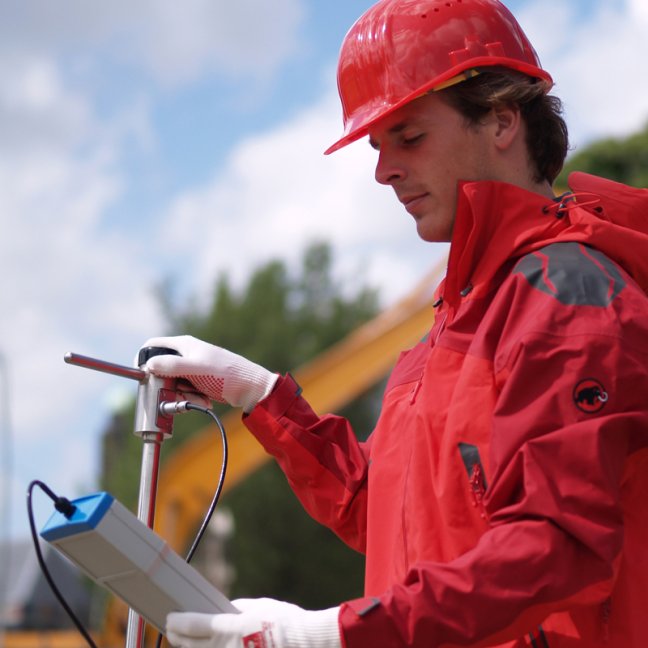
The Hukseflux product range includes two sensors specifically made for thermal conductivity measurements. The primary focus of the TP02 design is for laboratory experiments measuring in soils and foodstuff. The Primary focus of TP01 is in long term installation under the soil, as part of a meteorological station.

The TP02 is a needle shaped probe, suitable for repeated insertion into the medium. It behaves like the needle designs described in the literature. The TP01 is a unique Hukseflux design, and in fact a variation on the needle principle. More details about the measurement principle can be found in non-steady state probe science and in the product manuals.

TP01 now is also available as a turn key system: TPSYS.

In the STP01 Soil Temperature Profile Sensor, (although it is not specifically designed for high accuracy measurements of thermal conductivity) there is an additional possibility to crudely measure soil thermal conductivity at various depths. This is in the experimental stage. The measurement utilizes the heat-pulse or non-steady state probe technique.

The technique of measurement of thermal conductivity using the non-steady state probe or heat pulse, is special because it does not require a fully steady state. Generally speaking it utilizes line source heater, and analyses the temperature rise of the heater relative to the starting temperature, versus time.

Hukseflux measures thermal properties with the Thin Heater Apparatus

For the latest development at Hukseflux see THA-SYS.


top of page


Hukseflux Thermal Sensors - Elektronicaweg 25 - 2628 XG Delft 
- The Netherlands - Copyright © 1999 to 2008 
e-mail: info@hukseflux.com fax: -31-15-2574949