








Thermal science
In general "Thermal Sensors" is a broad category comprising various sensors based on- or reacting to temperature, from temperature sensors to thermal flow sensors. At Hukseflux we limit ourselves to sensors based on heat flux- or differential temperature measurement.
In many physical phenomena heat is exchanged. This goes together with heat fluxes and changes of temperature. Thermal sensors serve to measure those two quantities. When applied in the appropriate way, not only heat flux and temperature but also a number of other quantities can be measured, for example radiation and the flow of liquids and gasses.
Thermal sensors display some specific positive characteristics:
- extreme stability
- no moving parts
- large dynamic range
- little or no energy consumption
These characteristics will improve the reliability of measurement and control systems in which they are used. Below a common type of heat flux sensor, called thermopile, is used to explain some principles of measurement.
Thermal sensors can be used to measure various quantities:
Heat flux
- Heat flux (1) is induced by a temperature gradient across the sensor. The temperature difference is measured by a thermopile (2).

Radiation
- The absorber (1) absorbs radiation (2). The radiation is converted into heat. The heat flux to the heat sink (4) is measured by the thermopile (3).

Mass flow & heat transfer coefficients
- A certain amount of heat is generated by a resistor (1). The ratio between the heat that flows to the heat sink (5) and the heat that was originally generated, is a measure for the mass flow. This ratio can be determined using a thermopile (4).
- At the same time, the heat flow to the air (2) is proportional to the local heat transfer coefficient. This offers a direct way to determine heat transfer coefficients for different flow regimes (3).

Thermal properties of materials
- When inserting a thermal sensor and a heater into a medium, the thermal sensor's response to heating contains information on the thermal properties of the medium.
Typical applications are:
Heat flux
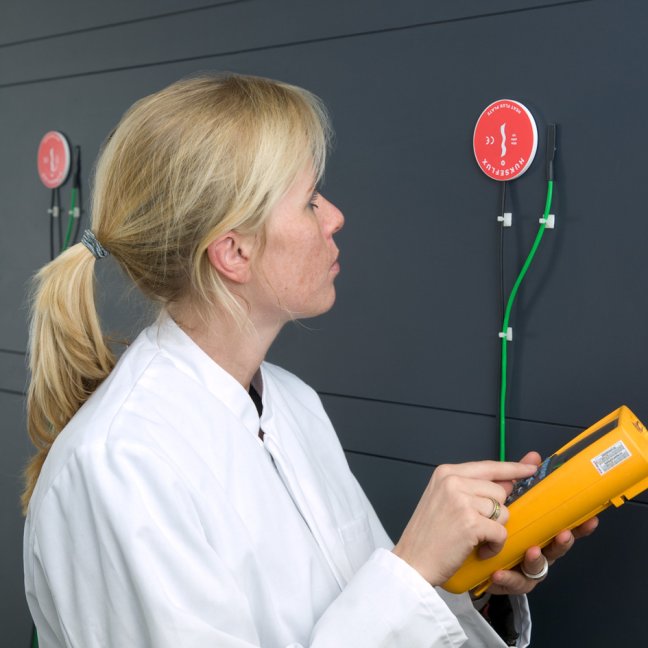
- Heat flux through walls, roofs and floors of buildings for efficient use of energy.
- Heat flux through soil for applications in agriculture and analysis of crop growth conditions.
- Heat flux from living beings to their surroundings for medical studies.
Radiation
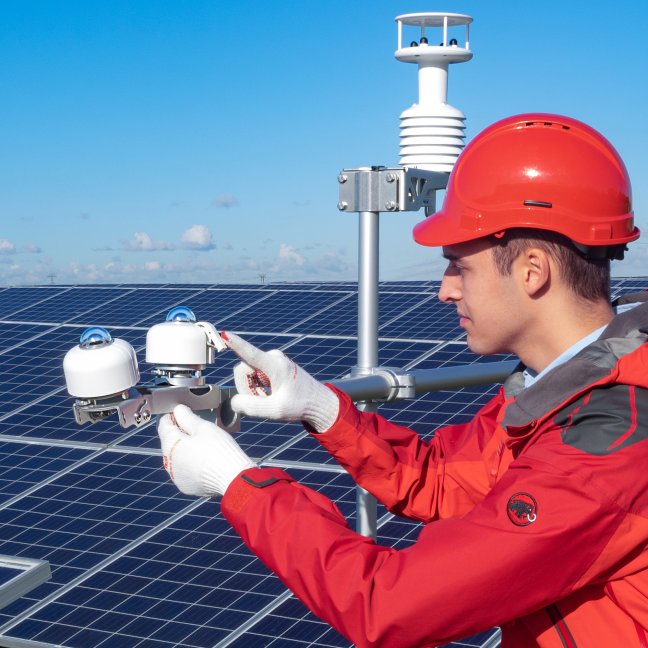
- Solar radiation for optimal control of solar collectors.
- Heat radiation of ovens for optimization of process conditions.
- Laser power measurement.
Mass flow & heat transfer coefficients
- Wind speed, particularly at low speeds in indoor climate measurement.
- Mass flow in pipes.
- Studies of heat transfer in drying processes, building physics etc.
Thermal properties of materials
- Thermal conductivity
- Thermal diffusivity